
13
cooling gadgets
that’ll make the heat actually bearable
The cooling gadgets category separates pretty clearly into the ones that actually lower temperature and the ones that are just loud and expensive.
Summer cooling typically breaks down into a few patterns: portable fans for flexibility, stationary fans for sustained airflow, and personal cooling devices that work when the room itself won’t cooperate. Here’s a collection spanning each.

Gaiatop Mini USB Desk Fan
There is a sub-eight-ounce USB fan that keeps turning up as a heavily reviewed pick in its category, and the review pattern lands on the same two words the listing uses: compact and powerful.
At under eight ounces with a head that tilts 0 to 30 degrees, this is built for the small-space end of the desk fan genre, the kind of thing that lives next to a monitor or in a car cupholder. Three speeds cycle through a single button, and it draws power from whatever USB source is nearby, laptop, power bank, car charger, no outlet required. The review pattern singles out two things worth noting: it holds up on an office desk, both in strength and in staying quiet enough to sit next to, and buyers keep describing it as good value for the price. That is the appeal in a category full of flimsy $8 fans that undersell themselves. The honest caveat, straight from the review summary: reliability is mixed. Some describe it working fantastically, others report it eventually stopping. For seven dollars, that seems to be a trade a lot of reviewers are willing to make.

Lasko Oscillating Pedestal Fan
The feedback on this pedestal fan splits hard down the middle – quiet and dependable for some households, loud and short-lived for others.
Pedestal fans all promise one thing – enough air movement to actually matter – and customer feedback on this Lasko keeps landing on the same word: tons. At 11.3 pounds with no-tool assembly, it is an unusually easy stand fan to unbox and get running in a bedroom. Height adjusts from 38 to 54.5 inches, and the tilt-back head aims the airflow somewhere specific instead of just blasting the whole room across a 60-degree oscillation – the reason it keeps showing up for bedroom duty more than living-room duty. The fused safety plug is the kind of spec nobody notices until it matters. The split worth knowing: some buyers call the noise quiet, others call it loud enough to notice, and a few report blades breaking off or the unit falling apart before its time. Decent odds, not guaranteed ones.

AC Infinity Register Booster Fan
AC Infinity’s vent booster claims a whisper-quiet 17 decibels, and the buyer accounts split almost evenly on whether that number holds up.
Register booster fans solve a narrow problem: one room that runs colder or warmer than the rest of the house no matter what the thermostat says. This one only fits a 4-by-10 duct opening — the listing repeats that twice — and pairs a dual 92mm engine with a CNC-machined aluminum frame built to sit flush against the vent instead of sticking out. The bluetooth app layers on heating-and-cooling triggers, timers, and ten speed levels, and the plainest account of what it actually does comes from a buyer who called their treated room the coolest in the house. Amazon’s own summary of the write-ups adds a second claim worth flagging: lower heating bills, credited to the fan doing work the furnace used to. Not everyone agrees on the 17-decibel spec — some call it quiet, some call it noisy — and a handful describe units that stop responding to the auto on/off timer after about a week.

Comfort Zone 12-Inch Tilt Fan
Amazon’s own summary of this fan reads like two different products, and that split is the most useful thing in the listing.
Comfort Zone’s 12-inch oscillator hits the standard checklist for a fan in this price bracket: a metal grille over the blades, three push-button speeds, and a head that tilts and swings side to side on a plastic base that snaps together without tools. Amazon’s own summary of shopper reports is oddly candid about where it lands. Airflow and value score well, and setup was fast enough that one buyer mentioned assembling it right before guests arrived. Noise is where the split shows up – some describe it as whisper-quiet even on high, while a second group reports a clunk as the head swings through its full sweep. Build quality draws the same divide: a portion call it cheaply made and flimsy, a few report it failing within six weeks, and plenty more say it’s still running fine months later. At a desk on a hot afternoon or beside the bed at night, the tradeoff is at least visible before you buy.

Hurricane Classic Clip Fan
A six-inch clip fan keeps turning up in grow tents and dorm rooms, and the airflow claims are oddly specific for something this small.
It clamps on with a two-inch grip, tilts to redirect airflow, and runs two quiet speeds — no drone, according to the people running it all day next to a desk chair. The two places it keeps showing up are grow tents and dorm rooms, where a full-size fan doesn’t fit and floor space isn’t an option. Reviewers put its throw at around twelve feet, an unusually long reach for something the size of a fist. The clamp is the inconsistent part: solid on a standard bar, less so on a narrow tent pole. Power draws mixed reactions too — some call it plenty strong, some call it weak, which tracks for a fourteen-watt motor asked to do a lot of small jobs.

Genesis Copper Motor Box Fan
A box fan owners keep wedging into a window frame instead of setting it on the floor it’s built for.
Box fans mostly look identical, which makes the copper motor on this one an odd detail to lead with — except owners keep bringing it up unprompted, alongside how much air it actually pushes for the price. The most common placement, going by what owners describe, is wedged into an open window rather than set flat on the floor — helped along by swivel feet that let the head angle up or down without sliding off a sill. The soft spot: motor life is inconsistent. Most units hold up fine, but a noticeable minority describe the copper motor giving out after about a year, and the noise draws a similar split — quiet for some, a low drone for the rest. It’s ETL-listed and UL-approved, with a fuse built into the plug, which is more paperwork than most box fans bother with.

MIYCOO Leakproof Cooler Backpack
A soft-sided cooler backpack whose side straps alone hold four bottles of wine, on top of a 40-can main compartment.
Calling this a cooler backpack skips the wine math worth noticing: two adjustable straps, one per side, each hold a bottle, putting four bottles of wine on the outside in addition to the 40-can main compartment. Customers keep landing on that detail, along with a bottle opener stitched into the shoulder strap so nobody’s digging through a beach bag for one. The two-compartment layout does what the listing promises — snacks and utensils on top, drinks and fruit below, insulated through the length of a beach picnic. Where the accounts split hard is durability: plenty land on years of use with no leaks, while a noticeable share mention tearing within days or a seam giving out once the ice melts. The pitch is the wine capacity. Whether the seams hold is the gamble.

Levoit Quiet Tower Fan
Most tower fans compete on wind speed; this one competes on how little you can hear it winning.
Most tower fans lead with top wind speed. This one leads with the opposite — how close to silent it stays at the low end of its range, which is an unusual thing for a fan to advertise as its main feature. The motor is a DC unit, and the maker’s own figures put the noise span at 20 to 43 decibels across five speeds plus a turbo setting, with the remote carrying a dedicated mute button for the display tone — a small detail that matters more at 2 a.m. than it sounds. It also pivots across three angle settings instead of one fixed sweep. It’s sized for a desk or nightstand, built with a carry handle so it can move between rooms rather than live in one permanently. The honest split in the customer data: some call it a steal at this price, and a smaller set call it overpriced for a fan this size. It’s not cordless.
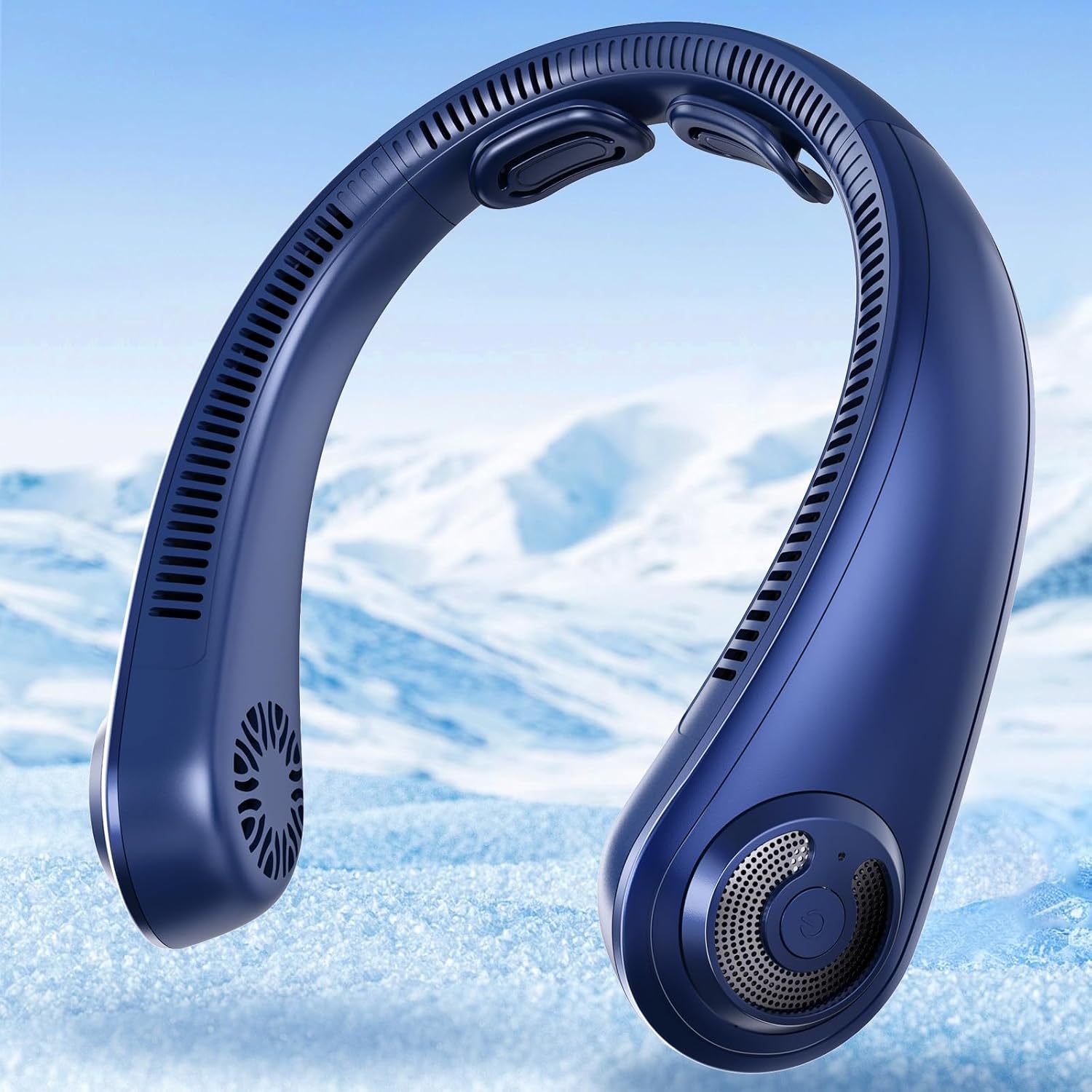
AUIIAH Wearable Neck Fan
This bladeless neck fan turns up constantly in hot-flash and outdoor-worker recommendations, with five speed settings doing most of the persuading.
A neck fan with no exposed blades sounds like a gimmick until the wind-hole design turns out to be doing real work: air divides at turbo-shaped vents instead of spinning past a blade, which is why it stays safe around long hair, kids, and grandparents. Five speed settings stretch the charge anywhere from a few hours to most of a workday, depending on how hard it runs. The use case that keeps surfacing is hot flashes and Florida-grade heat — buyers return to this one specifically for that, not just casual cooling on a walk. Battery life gets consistently good marks, and the lightweight, hands-free build seems to matter as much as the cold air itself. The honest caveat: noise is split down the middle. Some buyers call it whisper-quiet; a good share mention a distinct high pitch once it’s cranked up. Worth dialing it down a notch if quiet matters more than max cold.

Windmill Ultra-Quiet Smart Fan
The Windmill fan’s lowest speed is rated at 18 decibels, and multiple customers independently call it the quietest fan they’ve owned, a specific kind of praise for an appliance whose whole job is being ignored.
Five speeds split cleanly into two jobs. Whisper, Low, and Medium behave like a normal desk fan; High and Boost push it into circulator territory for a whole room. Controls are almost redundant on purpose, app, voice assistant, remote, or a soft-touch button all work, and it remembers whichever speed you left it on. Customers keep singling out the lowest speed as the quietest they’ve owned, which lines up with the 18-decibel spec on the listing. It’s small for what it does, 2.5 pounds, just over ten inches tall, tilts to aim. One customer’s note that it moved a large room’s worth of air is the kind of overperformance claim worth taking with mild skepticism given the compact frame. Worth flagging: the year-round pitch is about redistributing air a room already has, not generating heat. It’s a fan, not a heater, even if the copy implies double duty.

Pelonis DC Tower Fan
The DC motor here pushes real air by the numbers, and the people who own it keep circling back to how quiet it manages to stay.
This 42-inch tower fan runs on a DC motor, and the listing backs that with an actual figure: 2045 CFM, with air moving at up to 28 feet per second. Twelve speed levels stretch from a low hum meant for sleeping to a stronger push meant for right after a workout, and a sensor nudges the speed up or down as the room’s temperature shifts on its own. What people keep noting: it runs quiet while still doing real cooling, and more than one flags it as a surprisingly solid pick for wherever they sleep at night. It also shuts itself off after 24 hours untouched, a small detail aimed at anyone who tends to leave a fan running. The near-top score is worth reading against a set of ratings that’s still fairly small. Even so, a DC motor rated at 2045 CFM is not a spec most fans this size bother printing on the box.
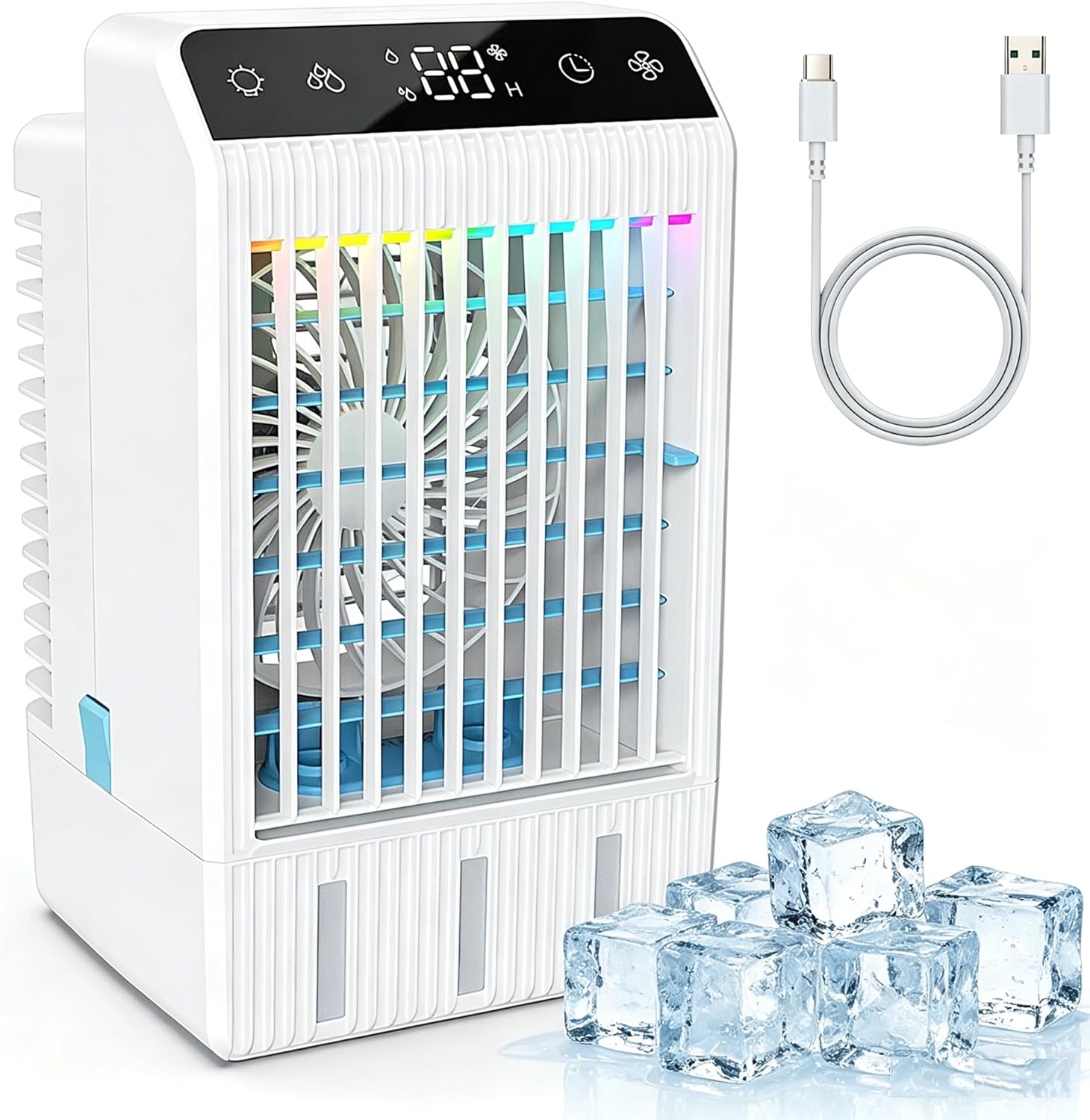
Tiptop Personal Mist Fan
A USB-powered mist fan that also handles humidifying, aromatherapy, and a night light out of one 1000ML tank — cooling is almost the fourth job on the list.
This is a five-in-one desk unit — mist fan, humidifier, aromatherapy diffuser, night light, and a 1000ML tank rated for twelve hours on low mist. A bead-bearing motor spins at 2000 rotations an hour via dual outlets, rated at 34 decibels and 8 watts of draw, low for a desk unit built to run overnight. It plugs into a power bank, a laptop, an adapter, or a car charger, which puts a tent and a dashboard in the same use case as a desk. Four fan speeds and two mist levels scale it from a small dorm room to a shared office, and a 60-degree vent tilts to redirect the stream on demand. One honest note: this is evaporative technology, not compressor-based air conditioning, so the real temperature drop depends on how dry the surrounding air already is — true of the whole micro-AC genre. The twelve-hour tank figure is specific to low mist; high mist means more frequent refills.

Fentara Misting Camping Fan
A 36,000mAh battery hiding inside a camping mist fan turns out to double as a phone charger, which is the detail buried under all the mist talk.
There’s a small crowd of camping fans that also spray a cooling mist, and this one pulls double duty in a specific way. A 460ml tank runs continuous mist for about ninety minutes, or stretches past two hours on the five-second-spray, three-second-pause cycle — ice water in the tank pushes that further. The battery is the bigger flex: 36,000mAh, rated eighteen to one-sixty hours depending on speed and mist use, and it moonlights as a USB power bank once the fan itself clocks out. A built-in hook lets it hang inside a tent or off a branch, or it sits flat on a non-slip base as a desk unit, head tilted either way. One instruction worth flagging: dont run the mist while its hanging — fan-down only. Reviewers keep crediting the spray for things beyond cooling, like clearing garage fumes and drying sweat fast after yard work. An unusual amount of gear packed into one battery, for not much money.